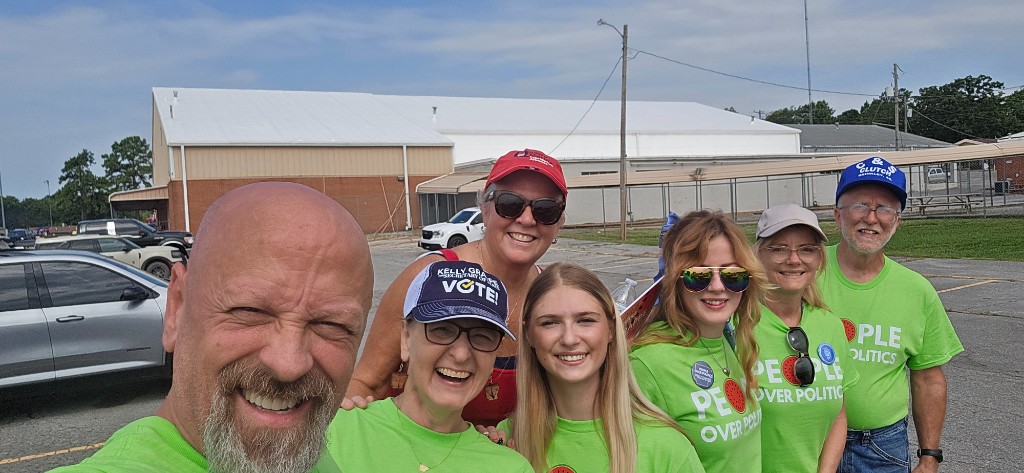
Join the Field Team
Section 1
How this works
Small teams, clear lanes, steady progress.
We organize in small 3-person teams. Each team has three coordinators:
- Events — gatherings, tabling, and volunteer meetups.
- Social media — sharing campaign-approved content and lifting up local activity.
- Power of 5 / voter registration — relational organizing: people you know, respectful follow-up, and connecting folks to registration when it fits.
Each person owns one lane. The goal isn’t to overwhelm volunteers — it’s to make small weekly actions stack up across many people and many communities.
Discord is our day-to-day communication space. Your dashboard keeps the work organized; Discord helps your team stay connected. Joining Discord is encouraged. Automated Discord bot routing comes later — never post voter data or private voter information in Discord.
Section 2
How to build a 3-person team
The model does not start with three people. It starts with one person willing to take the first step.
Start with one person
Every team starts with one person willing to take the first step. That person does not need to have all the answers. Their first job is simple: recruit one more person.
Recruit the second person
The first two people become the starting pair. They put their heads together, look at who has already signed up to volunteer, and identify people who may fit the missing roles.
Recruit two more people
The starting pair recruits two more people so the team has coverage for the three lanes: Events, Social Media, and Power of 5 / Voter Registration.
Important note: The original recruiter becomes the campaign upstream contact for that team. They are responsible for helping information move up to the campaign and back down to the local team.
Build geographically
All teams must be geographic in nature.
- If the three people are from different cities in the same county, they are a county team.
- If the three people are from the same city, they are a city team.
- If the three people are from the same precinct, neighborhood, campus, church community, or local area, they are a local team.
The more local the team is, the more powerful the organizing becomes.
Build downstream teams
Every team's job is not to become bigger. Every team's job is to help build more teams.
More teams, not bigger teams.
- A county team helps launch city teams.
- A city team helps launch precinct or neighborhood teams.
- A precinct team helps launch block, apartment, campus, or community teams.
- There can be multiple teams at every level.
- Teams should multiply instead of expanding into large, hard-to-manage groups.
Team levels
Same three lanes at every level — geography decides which level you are.
County team
Best when
Members are spread across multiple cities in the same county.
Primary job
Launch city teams.
City team
Best when
Members are in the same town or city.
Primary job
Launch precinct, neighborhood, campus, or community teams.
Precinct team
Best when
Members are in the same precinct or voting area.
Primary job
Organize voter contact and local relationships.
Neighborhood / block / community team
Best when
Members share a very local area or natural community.
Primary job
Relational organizing, event turnout, and voter registration support.
Recommended simple flow
- I will start.
- I will recruit one more person.
- We will look at volunteer signups and our own networks.
- We will recruit two people to cover the missing lanes.
- We will define our geography.
- We will choose our upstream contact.
- We will begin weekly tasks.
- We will help launch the next downstream team.
Before your team launches
- We know our geography.
- We know our level: county, city, precinct, neighborhood, or community.
- We have someone covering Events.
- We have someone covering Social Media.
- We have someone covering Power of 5 / Voter Registration.
- We know who the upstream campaign contact is.
- We know where to send updates.
- We know our first weekly tasks.
- We know what downstream team we want to help build next.
The rule of three
A team should stay small enough to move quickly. If more people want to help, that is a win — but the next step is to launch another team, not make the original team bigger.
Example
Sarah signs up in Creek County. She asks Marcus to help her start. Sarah and Marcus review volunteer signups and realize they need someone who likes events and someone who is comfortable posting online. They recruit Dana for Events and Luis for Social Media. Sarah stays the upstream contact. Because the team members live in different towns, they are a county team. Their first goal is not to grow to ten people. Their first goal is to help Sapulpa, Bristow, and Drumright each start their own 3-person city team.
Section 3
The three roles
Pick the lane that fits your gifts — you can adjust later with your team.
Events Coordinator
Helps identify, plan, and support small local gatherings, tabling opportunities, house meetings, community events, and volunteer meetups.
Weekly tasks
- Find or suggest one local event opportunity.
- Help invite people to one gathering.
- Report event needs back to the team.
Social Media Coordinator
Helps amplify campaign-approved content and local volunteer activity online.
Weekly tasks
- Share approved campaign content.
- Invite friends to follow campaign channels.
- Capture photos or updates from local activity when appropriate.
Power of 5 / VR Coordinator
Helps volunteers identify five people they personally know and move them toward support, signup, voter registration, or action.
Weekly tasks
- Ask each volunteer to choose five people.
- Encourage one relational organizing touch per week.
- Help connect voter registration opportunities to local activity.
Section 4
Your first 15 minutes
A simple sequence anyone can finish today.
- Read this page.
- Pick the role that feels easiest for you.
- Complete the volunteer signup form.
- Invite one friend to look at this page.
- Join or help start a 3-person team in your area.
Section 5
Pick your lane
No wrong answers — this just helps you orient before you sign up.
Section 6
Want the full field guide?
The full playbook explains how county, city, precinct, and neighborhood teams work together.
When you are ready to go deeper, the field playbook walks through the same three roles at every level — so you always know what “good” looks like.
Section 7
Join our campaign
Complete the volunteer signup form and someone from the campaign will be able to connect you to the right local team.
After you sign up, use the volunteer resource library, bookmark this page, or open the field playbook — your team can run the weekly rhythm there.
After signup
What happens after you sign up?
A simple picture of what comes next — details may vary as we finish moving tools onto this site.
- Your information is received by the campaign.
- Automated emails begin once campaign email automation is live.
- You receive onboarding materials and next steps.
- A coordinator may connect you with a local team.
- If no team exists yet, you may be invited to help start one.
- You can immediately use the field playbook and resource library to begin.
Share this page with a QR code, text message, or social post. A new volunteer can start here without needing a long explanation.